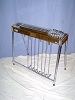
I would like to share about my PSG and copedent that I came to after a lot of research and trial and error. I play for about 3 years now and regard myself still as beginner but have a background of 45 years of guitar. My first PSG experience was with an old Emmons SD10 4x3 with E9 standard Emmons setup.
When I decided to have a custom built guitar I searched for an universal S10 concept maybe more on the 6th side of things. I finally have found it in Bob Lees D6th Hybrid tuning which I think is absolutely brilliant. Here is how Bob has described it:
My guitar is a beautiful and perfect build by WBS (Germany). It is a SD10 8p6k and has Bobs copedent with some changes and further additions, so I call it „D6th Hybrid Plus“.
P2&3 are the AB pedals in Day configuration. P3 has also a +1 raise on str1 as often found on a knee lever with E9. Here it delivers some unison bend sounds fitting well with the str5 raise for minor blues sounds and also a nice maj7 sound with P2.
P1 takes the spot of the omitted C pedal. The +1/2 on str1 can be found on E9 as well as C6 copedents and gives a nice bluesy inflection esp. together with P2. The +1 on str6 is here the main function which is again a typical knee lever pull in E9 (and sometimes C6) including the split with P2. The +1 on str9 delivers the lowest open string in E9. There are some nice dense voicings for the lower register and also some pentatonic scale options when You combine P1 with other changes like LL1, LL2, P2, RL and RR.
P4&5 are the standard P5&6 in C6. From an E9 perspective P4 is the 5th lower sound, typically implemented as vertical lever splittuned with the A pedal. Some prefer it next to the A pedal (f.e. Travis Toy). This is basically what we have here.
P6 is the often added „reverse P6“ in C6. Next to P5 it is easy to switch between the two for some variation. Nice also with P7 for a #11 extension. With the low F on str9 it is also the foundation for a split version of Doug Jernigans P4. Therefore combine it with P7, LR and optionally RR. I have the idea from Rick Schmidts copedent.
P7 is the boowah pedal but kind of inverted. For the original boowah sound You have to combine it with LR. The -1/2 on str3 is typically found as a single knee lever in C6. I have it also on LL2 but together with -1/2 on str7 which is typical E9 but not so C6. So I have it replicated here in C6 fashion.
P8 is the C6 P7 but kind of reversed as the +1 on str3 is moved to the lower octave on str7. I find it much more usable this way and the higher note I can also get via str1 or LV. The +1 on str4 also delivers the missing open string 2 of E9 which should be combinable with an unaltered or lowered str3 for some E9 sounds. So this is another reason to have it setup this way. I use P8 most often with the right foot, so it can be combined with almost everything. One interesting combo is with RL.
LL2 and LR are the E lowers and raises in E9, LR is also typical for C6.
LL1 is more C6 („Reece“) but also one half of the Franklin pedal in E9.
RL is typical C6 as is RR. RR also substitutes for the missing open str9 and halftone-lowered str2 in E9.
The LV is a special thing in Bobs copedent I kept. It completes the AB Pedals for a C pedal function. Also keep P2 pressed and LV will constitute together with RR an alternate version of the AB pedal move which is typically found on Eb9/Bb6 Universal Tuning copedents.
So there You have it. I am curious about Your feedback. Maybe there are some questions. Do You think I fell into the “one thing that does everything” trap or found some nice choices for hopefully a well rounded copedent? It sure was fun to plan and more so to explore in reality.

Marco