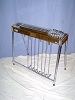
The gents above are steering you right. The C-pedal is usually used along with the B-pedal to get a minor chord. Please note that, unlike most everything else, it does not work with all of the standard grips. Specifically, you will
not use it with a lower grip that incorporates the 8th string, but it
does work on those treble grips that incorporate the 4th string.
Here's another view of the same thing discussed by others in this thread, taken from instructional material I wrote that shows the fretboard positions of one minor chord, played up and down the neck. You can get tons of mileage, sliding
between these positions while the strings are still ringing:
Map of a Minor Chord.jpg
.
Here’s a memorization trick: The BC pedals and the E-lower positions shown in the middle of the chart are sort of “twins”. They’re only 2 frets apart.
In fact, when practicing, I frequently play this up-and-down sliding move to reinforce the fact that wherever you find one, the other is only 2 frets away:
I play: BC pedals– sliding down 2 frets to – E-lower Knee – sliding back up to BC. It’s a cool little lick, and it helps you learn those 2 positions quickly. It’s the same chord in two different frets that are conveniently close to each other.
I think of these 2 positions as one position, really… just like people sometimes think of a set of twin sisters as one unit.
Once you’re comfortable with that “twin” combo, it’s easy to remember that the A-pedal version of the chord is 5 frets away from either end of the twin-pair.
See the chart above to verify that the A-pedal position is 5 frets
above of the BC side of the ‘twin’ -- and 5 frets
below of the E-lower side of the twin.
Also, note that the two A-pedal positions at each end of the chart above are one octave apart from each other (12 frets apart).
You do not have the required permissions to view the files attached to this post.